The Baobab Gathering London - live FREE in-person event
Mon 27th April 2026
THE VISION
By Monday, 27 April, Skoll is over. Four days of panels, pitches, cocktail receptions, and polite networking have left people energised but exhausted. The African contingent, in particular, has spent the week performing for funders: making the case, telling the story, proving the impact.
They need somewhere to exhale.
‘The Gathering’ is that somewhere. It is not another conference. It is not a showcase dressed up as a networking event. It is a deliberate shift in register: from performing to being, from pitching to connecting, from consuming content to building relationships.
The Africa Centre in Southwark is the ideal home for this. It is not a conference venue. It is a cultural institution, a living room for Africa in London. The architecture, the art, the food, the music all signal: you are in an African space now. The rules are different here.
You can join us for the whole day, from 2pm-10pm, enjoy good company food and music or you can join us for whenever suits you, for an hour or more. There will be plenty of conversations and discussions.
It’s helpful if you can register with us so we can track the numbers and keep in touch.
THE LOCATION
The Africa Centre
66 Great Suffolk Street
London
SE1 0BL
https://www.africacentre.org.uk/
Here are some of the organisations that you can meet in the Partner Space - find out about their work and make new friendships.
In all, we expect there to be 50 African organisations at the event.
The will be one of London’s largest gatherings of African civil society.
Eight hours. Five spaces. One purpose: to give African leaders, their allies, and their funders a place to do real business, have real conversations, and celebrate what they are building, in a setting that honours African culture and hospitality.Who is coming?








THE THREE ACTS:
Starting at 2pm and finishing at 10pm, the day moves through three distinct acts, each with a different energy and purpose. The arc is intentional: from structured thinking to active connection to joyful celebration. People can arrive at different times and still find their entry point, but those who stay for the full journey experience a complete story.
-
Come together. Set the frame. Go deep.
2:00pm – 3.15pm
2:00 – 2:15 | ArrivalsGuests arrive to African tea, coffee, and light refreshments in the ground floor restaurant. The atmosphere is warm and unhurried. Background music from African artists sets the tone. A printed programme card guides people through the day’s three acts and helps them plan which sessions and spaces to visit.
A “Connections Board” in the restaurant allows people to post requests: “Looking for funders interested in assistive technology in East Africa” or “Want to meet anyone working on youth employment in West Africa.” Simple, analogue, effective.
2:15 – 3:15 | Opening Plenary: The Unfinished Conversation
The format is a moderated conversation, not a panel. Three voices, one moderator, 45 minutes, then 15 minutes of audience exchange. The moderator’s job is to create tension and honesty, not to manage polite turn-taking.
Voice 1:A funder who is genuinely rethinking their approach to African grantmaking. Not performing allyship, but sharing what they’re actually changing and why. This person needs credibility and candour.
Voice 2:An African leader who has built something durable, not because a funder told them to, but because they understood that survival demanded it. They speak about what it cost, what it taught them, and what they’d tell their peers.
Voice 3:A diaspora perspective that bridges the room. Someone from the African community in the UK who is engaged in development, investment, or philanthropy back on the continent. Their presence signals that this isn’t a conversation between Africa and the West; it’s a conversation among Africans and their allies.
-
Build relationships. Do business. Go deeper.
3:30pm – 6:20pm
3:30 – 4:20 | Discussion Group 1 (Feeny Room)
From Diaspora to Power: Who Really Controls Capital for African-led Change? - Led by Carol Akiwumi MBE of the Avocado Foundation
This is not another remittances conversation. It’s about the civic, political, and entrepreneurial contribution of Africans living in the UK and how that connects to development on the continent.
How are diaspora professionals using their skills, networks, and political voice to shape outcomes in their countries of origin? This session will create space for dialogue around the role of the African diaspora, not just in representation, but in shaping power, capital, and decision-making.
4:30 – 5:20 | Discussion Group 2 (Feeny Room)
“What Works: The Art & Science of Partnering with Government” - Led by Carolyn Kandusi
Distill practical, evidence-based patterns that enable effective partnerships between government and the social sector—moving from engagement to sustained scalable impact.
5:30 – 6:20 | Discussion Group 3 (Feeny Room)
“Power in Practice: Rethinking Women-Led Impact” - Led by Lydia Charles Moyo of Her Initiative
Reframe women-led work as power in practice by highlighting how women-led organizations design, deliver, sustain impact differently and what this means for building stronger, transformative communities.
The Builders’ Marketplace (Arch29, 3:30 – 6:20)
While the Feeny Room hosts discussion groups, Arch29’s ground floor transforms into the Builders’ Marketplace. This is not an exhibition. There are no banners, no stands, no brochures on tables. Instead, 10-15 African organisations each host a “conversation corner”: a small table with a single provocation question printed on a card, and two chairs.
The provocation question captures the most interesting challenge or insight from their work. Visitors sit down, read the question, and have a conversation. It is intimate, human, and radically different from the typical conference booth. Each partner is briefed in advance: this is not a pitch session. Your job is to start a conversation, not deliver a presentation.
-
Showcase. Inspire. Remember.
6:45pm – 10:00pm
6:45 – 7:30 | The Partner Showcase (Arch29 Ground Floor)
Five African leaders. Three minutes each. One story.
Not a pitch. Not a summary of their organisation. One story that captures the heart of what they are building. A moment. A person. A turning point. The brief is deliberately narrow because constraint produces the best storytelling.
7:30 – 8:00 | Closing Keynote
A single voice to close the formal programme. This speaker must be someone the room respects deeply: an African leader of stature who can reflect on the day, name what was felt in the room, and send people into the evening with something to carry home.
The keynote is 15–20 minutes maximum. It is not a lecture. It is a closing meditation: what did we do here today, why does it matter, and what comes next?
8:00 – 10:00 | The Celebration
The formal programme ends. The celebration begins. Arch29’s mezzanine opens for a full drinks and canapés reception. The Centre bar hosts live African music. The restaurant serves a dinner spread. People move between spaces, carrying the energy of the showcase and keynote into conversation, laughter, dancing, and connection.
This is not an afterthought. It is the point. The structured programme creates shared references.
The celebration converts those references into relationships. Every major partnership, funding commitment, and collaboration that comes out of this event will likely trace its origin to a conversation that happened between 8pm and 10pm with a drink in hand and music in the background.
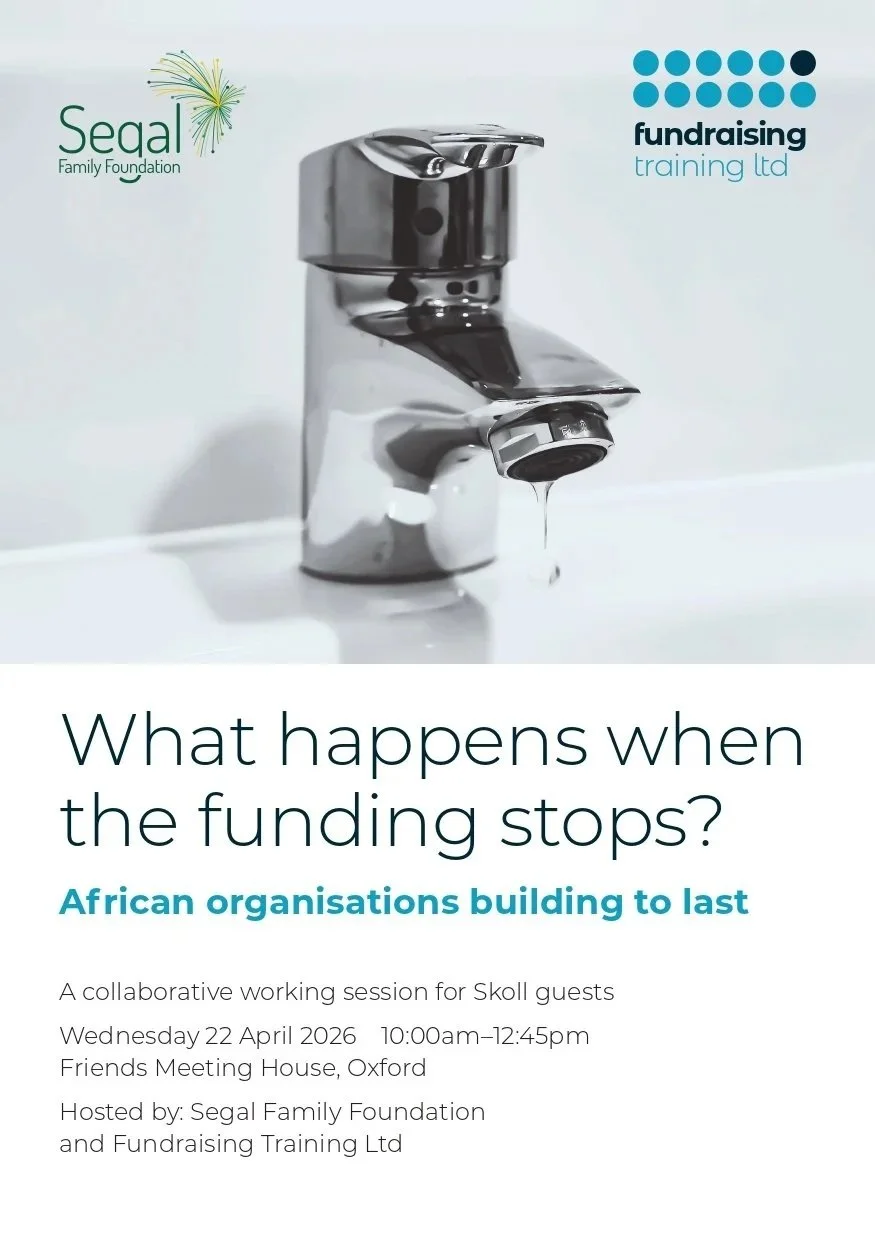
What Happens When The Funding Stops - live FREE in-person event
Wed 22nd April 2026
A partnership between
Segal Family Foundation
&
Fundraising Training Ltd
Every year at Skoll, African organizations show up with energy, insight, and ambition.
They pitch. They network. They collect business cards from funders who say they'll follow up. Some do. Most don't. And the organizations return home to the same structural reality: their survival depends on the next grant cycle.
This is the elephant in every Skoll meeting room.
Funders write “sustainability” into every strategy document. Grantees include “sustainability plans” in every proposal. But the fundamental dynamic rarely shifts. Grant-dependent organizations remain grant-dependent, and the sector keeps pretending otherwise.
This session breaks that pattern. Instead of another panel where experts talk and funders listen politely, we're putting practitioners and funders at the same tables to confront the problem together. Not to perform. Not to pitch. To work.